Wednesday

.

| To write a children's book or a tale for children/adults:

  "You've got to build in a sense of your audience as part of the way in which you're tough with yourself about what you're writing. Part of that reading child will inevitably be the reading child you once were. That's no bad thing, but quite often, I would suggest, this is not sufficient. You also need to get that child who is now the age of your target audience into your head too. "
 
                                                                                      Michael Rosen|

.

| Tomas Nilsson and his wonderful different way of telling a story:


Slagsmålsklubben - Sponsored by destiny from Tomas Nilsson on Vimeo.|

.

| Marcel Wanders
the founder of a Dutch furniture manufacturing company, crearted this promotion project for London Desgin Week 2011, although it's not telling a story exactly, it's taking elements of a story and morphing them into something different, something in an advertisment field |


Monday

.

| looking more into ways of representing stories, intead of cornering myself into one idea:

This “tower of books” sculpture entitled Idiom by Slovakia-born Matej Kren, can be seen at the Prague Municipal Library, in Prague |      

.

| Ilana Yahav - http://sandfantasy.com/about-me/


Yet another way of representing a story, I like that her stories are never the same twice because of the methods she uses. |

Videos.

|Looking at more shadow puppets I managed to find several very interesting videos relating to it - which are along the same themes, but with an animation edge, everythings alot more crisp and clean, which I quite like:


The Invention of Love (2010):  I think this was made by graduate students, but it's still very beautiful.


The Tale Of The Three Brothers from Harry Potter and The Deathly Hallows Pt. 1:
                          
"In an interview with the Los Angeles Times, animator Ben Hibon spoke about the inspiration behind and the creation of the gorgeous animated sequence in Harry Potter and the Deathly Hallows: Part 1.
                           This is the first animated sequence ever to appear in a Harry Potter film, so it had to be distinctive and special. It’s not animation as we might think of it today; it is a moving illustration of the story being read aloud by Hermione — the story of the Deathly Hallows. The fact that the sequence would be explaining the origin of the title made it all the more important."
…
"The work of artist Lotte Reiniger from the 1930s was another early reference. Her silhouette-style stop-motion animations are beautifully handcrafted and captured the naïve visual tone we were after. We also looked at Asian shadow-play, which is visually striking, very intricate and yet so beautifully simple. The technique is basic, but the end result is particularly charming and engaging. There’s something so ingenious about projecting shadows onto a simple cloth."
   
                                                                                    http://www.harrypotterfanzone.com/BenHibon


Red :  Not really in the same vein as what i've been looking at with shadows, but it was thrown up when i was looking at the animation aspect of the stories, also it's a nicely different take on the story of red ridinghood. I like the pencil style of the work and how the original drawing guide lines are still there - I like also the colour pallette they used.


Vincent: Tim Burton's short film is a brilliant example of a stop motion animation, and I chose to look at this from a personal point of view (because I am a big fan of Tim Burton in general and the feel he gives to films he works with and films he puts out himself) and also from a character creation point of view - his vivid illustrations make characters easy to connect with.
      For example:  


A book I have a copy of at home, brilliant and very corporeal for illustrations.

.


| I think the reason i'm attracted to most of these covers and illustrations and images is becaue it reminds me of shadow puppet theatre (left).
       I like the different ways of telling the stories that i've been looking at, I started wanting to just look at the reasons behind it and the deep moral issues and everything involved with the actual stories, but I think i'm actually more interested  in this style now, maybe I could illustrate my own story and create my own characters with a slightly more adult edge to my story and see how I can represent it in different ways? |

Friday

.


Taken from Asos magazine, I really liked the front cover of this book, which is another kind of adult oriented fairy tale, with lots of elements of old fairy tales mixed in:


I like the illustrated cover but I think I prefer the UK cover with the Silhouetted outline of the girl and the fox and the trees.

.


||

Thursday


|A rough sketch and idea based on the illustrators I've been looking at, I had 'The little mermaid' in mind when I chose to draw this, the Disney version where ursula turns into a giant kracken at the end, but chose to make it slightly more realistic. (well not realistic, but more realistic than a giant squid woman.)|
| All of these illustrations are reminding me strongly of my favourite illustrator and print artists ever, Aubrey Beardsley.

Although controversial I consider Beardsley to be an incredibly skilled and multi talented artist who was abit unusual in both his personality and his choice of work, I like that he didn't really believe in Taboos and would work for the love of working. Very intricate and nearly always black and white, his illustrations are classic of the Art Nouveau style. |
| Someone who struck me purely because he illustrates and writes at the same time is Chris Priestley (http://chrispriestley.blogspot.com/) I haven't read his books so I can't vouch for the themes of his books but I assume there along the same lines as we've already found with the others, I really like his illustrative style too:|


.

|Starting off with some books that I remember really connecting personally with the artwork and imagery behind them:


Published by HarperCollins, I really liked this releasing of the books (i'm not proud to say I have all of them at home, that's right...all 12 or 13). There have been many different versions including a cover that tied in with the film, but I think this looks more classic, using a basic colours and each image was only half realised and had something to do with what was inside the book (The front of this, the first book, starring Madam Octa).

I can't find the exact artist/company who designed this, but i'll find out and get back to it.


Again published like HarperCollins, A Series Of Unfortunate Events had a big impact on my early literary reading, the most beautiful illustrations with this book from fantastic Brett Helquist (http://www.bretthelquist.com/) who is beyond amazing. I do prefer his black and white sketches to the coloured in full versions. The cover image on left is the US cover, which looks more like a library book which is a very unique thing to do with a childrens book, making it look like an adults book.
An example of his work:

"Lemony Snicket's A Series of Unfortunate Events is one of the bleakest and most frightening children's book series. The first book is titled "The Bad Beginning", and from there it only gets worse. For starters there's Count Olaf and the fact that the kids' parents died in a fire, and the recurring symbolic symbol of an eye which usually means something bad (much like oranges in The Godfather trilogy)... "
                          http://tvtropes.org/pmwiki/pmwiki.php/NightmareFuel/ASeriesOfUnfortunateEvents


The books have a strong sense of moral relativism: the Baudelaires become more confused during the series about wether they are in the right or wrong, feeling they have done bad things even though they are to bad people, does the end really justify the means.

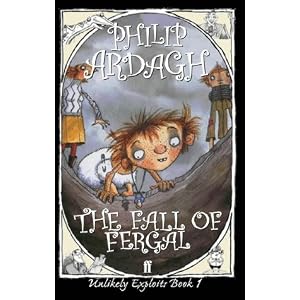
Published by Faber and Faber, Awful End is a chilrens book by Phillip Ardagh, illustrated by David Roberts (http://www.davidrobertsillustration.com/) who again, mainly due to reading these books is a favourite illustrator of mine, he again works in a very similar way to Brett Helquist (lots of black and white lines) possibly ink drawings mostly with watercolour finnish, an example of his work:

The books themselves have a strong sense of family ties and again a morality code within them, such as wether or not to complete a potentially bad act to save the life of someone else.

Also by the same author and illustrator:

 
with many of the same themes, this time in a more obvious way, this book i'm almost ashamed to say I read when I was a little bit older (purely because i loved the author and his other stories so much), but in a way I think thats a very good thing, because if I had read it at the age bracket it's intended for I think I would've got abit scared. There is a far higher desensitivity at a young age to the kind of concepts the books deal with. Not necessarily real things that could happen, but very unusual things. |
  

.

| Going to go back to basics with the actual stories, in my second to last project I looked at lots of old fairy tales and lots of related work, which I'm still going to refrence, because I think I built up a good work base:  http://risefallstealmake.blogspot.com/

I also want to look toward new stories that prehaps I read as a child/teen, lots of which I realise now had quite dark undertones, but very beautiful illustrations.

A relevant article that grabbed my attention a while back: http://www.telegraph.co.uk/Moraltales

    "Politically carrect parents who shun traditional fairy tales are missing the chance to teach their children right from wrong, an educational expert claims;
      
But Sally Goddard Blythe, a child development expert, argues that stories including Rapunzel and Cinderella are crucial to children’s development. They nurture moral behaviour and show young people the strengths and weaknesses inherent in human nature, by contrasting good and evil, rich and poor and vanity and valour, she says.
In a new book, The Genius of Natural Childhood, she argues that while fairy tales may tackle difficult issues such as the death of a parent in Cinderella, they prepare them for life in the real world.
They also enlist "children’s innate wish for good to triumph". |

.

|I started to think that many of the stories that young people are told (both old stories and modern day ones) have a hint of adult themes in them, and most of them are morality tales. Many originated as tales that started off with a darker side, e.g. Sleeping Beauty was originally raped by the king while she was in her coma and gave birth to two sons. But were skewed either by publishers or writers to be more friendly, e.g. a prince kissed her and she woke up and lived happily ever after.
 While thinking about this, i've been keeping an eye on all the new films that seem to be trending at the moment to do with retelling stories or rehashing versions of old ones, for example:


As just a few, all have moved the original "nice" meanings from the stories to make more adult themed films.
Most have a new element of horror added to them, which started me researching on the moral themes within actual genred 'Horror' films:
                                          
                                    
"Horror Subgeneres might be organised around ideaologies, say, of the family, or of women's independence, or the larger overreaching themes of narative opositions such as good and evil, or life and death. These themes are organised insuch a way to bring stable cohreant meaning to the genre" 
                                                        Page 27, 'The Horror Genre: Form & Function' Brigid Cherry.

"Wells (2000 6:7) lists the grand narratives of Horror to be:
                - Social alienation
                - A deep crisis of evolutionary identity
                - A need to express the implaction of human existence in an appropriate aesthetic."

                                                         Page 168  """|

.

| At the start of this project I'm really excited to go backwards (if that makes any sense). I like the idea of gaining lots of different outcomes from the same idea (The fairytale//redridinghood video from the end of Y1). So far I've had that video, and then a video that took the themes and the edges of that project and disected them to make a video about something entirely different (compulsive behaviours etc.).
Now I want to take the asthetics of the first project and make something different again, here were some of my ideas from my proposal tutorial:


There are many areas that i'm interested in looking at :) |